
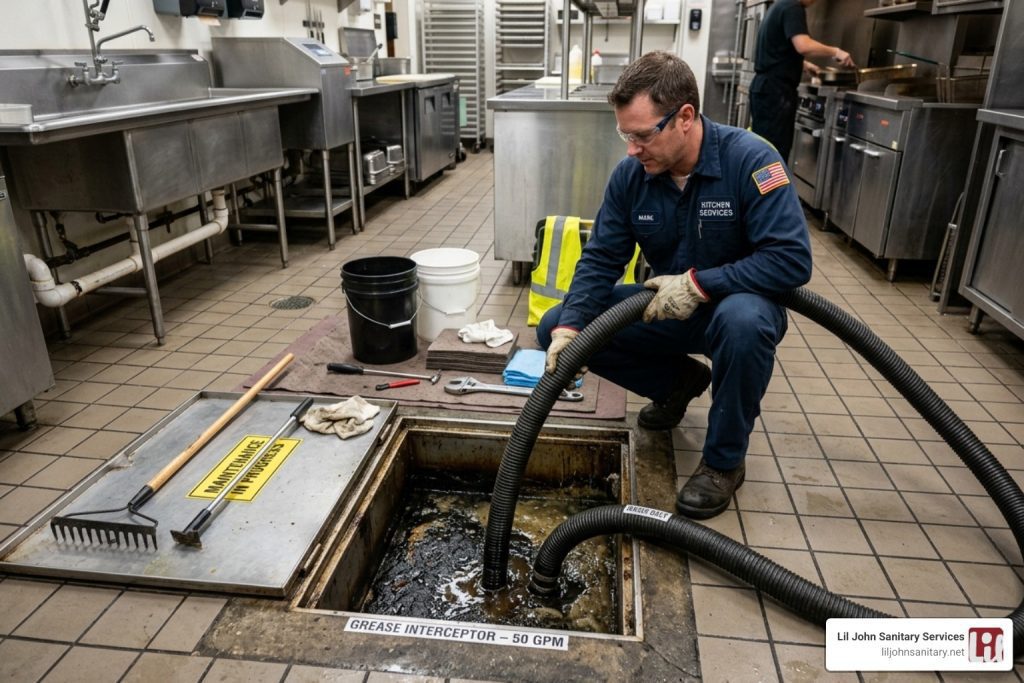
Commercial grease trap cleaning is the professional process of pumping out, scraping, and inspecting the device that keeps fats, oils, and grease (FOG) out of your sewer system — and it’s required by law for virtually every commercial kitchen.
Here’s what you need to know at a glance:
- What it is: Removing accumulated FOG and food solids from your grease trap or interceptor before they cause blockages
- How often: Every 1 to 3 months for most kitchens, or whenever FOG and solids reach 25% of the trap’s total capacity
- Who needs it: Any food service operation — restaurants, cafeterias, hotels, hospitals, food trucks
- What happens if you skip it: Drain backups, foul odors, health code violations, and fines that can exceed $5,000
- Who should do it: A licensed professional with vacuum equipment and permitted waste disposal — not general plumbers
Every commercial kitchen produces FOG. It’s unavoidable. Hot grease flows easily down a drain, but as it cools inside your pipes and trap, it solidifies into a thick, stubborn layer. Over time, that layer builds up — and if it’s not removed on a regular schedule, it doesn’t just stay in your trap.
It moves downstream. Into municipal sewer lines. Where it combines with other waste and hardens into what engineers call a fatberg — a mass so severe that the largest one ever recorded weighed 130 tons and stretched 820 feet through London’s sewer system.
That’s an extreme example. But the everyday consequences for a commercial kitchen? Slow drains, sewage backing up into your kitchen, a health inspector shutting you down, and a repair bill that dwarfs what routine maintenance would have cost.
The good news: a consistent professional cleaning schedule prevents all of it.
Understanding Commercial Grease Trap Cleaning and How Systems Work
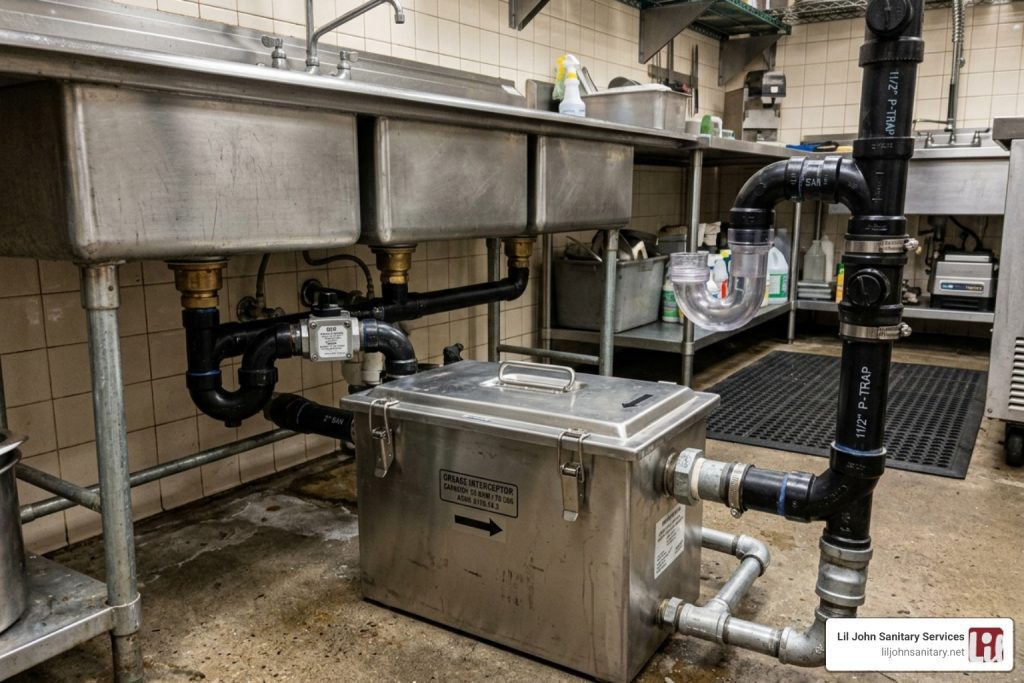
To keep your kitchen running smoothly in places like Bellingham or Mount Vernon, you first need to understand the equipment hiding under your floor or behind your building. While they are often used interchangeably, there is a technical Grease Trap Vs Grease Interceptor Whats The Difference/ that every owner should know.
A grease trap is typically a smaller unit (under 250 gallons) installed indoors, often right under the 3-compartment sink. A grease interceptor is a high-capacity tank (500 to 5,000+ gallons) buried outdoors. Both serve the same purpose: acting as a “speed bump” for wastewater.
The Mechanics of FOG Separation
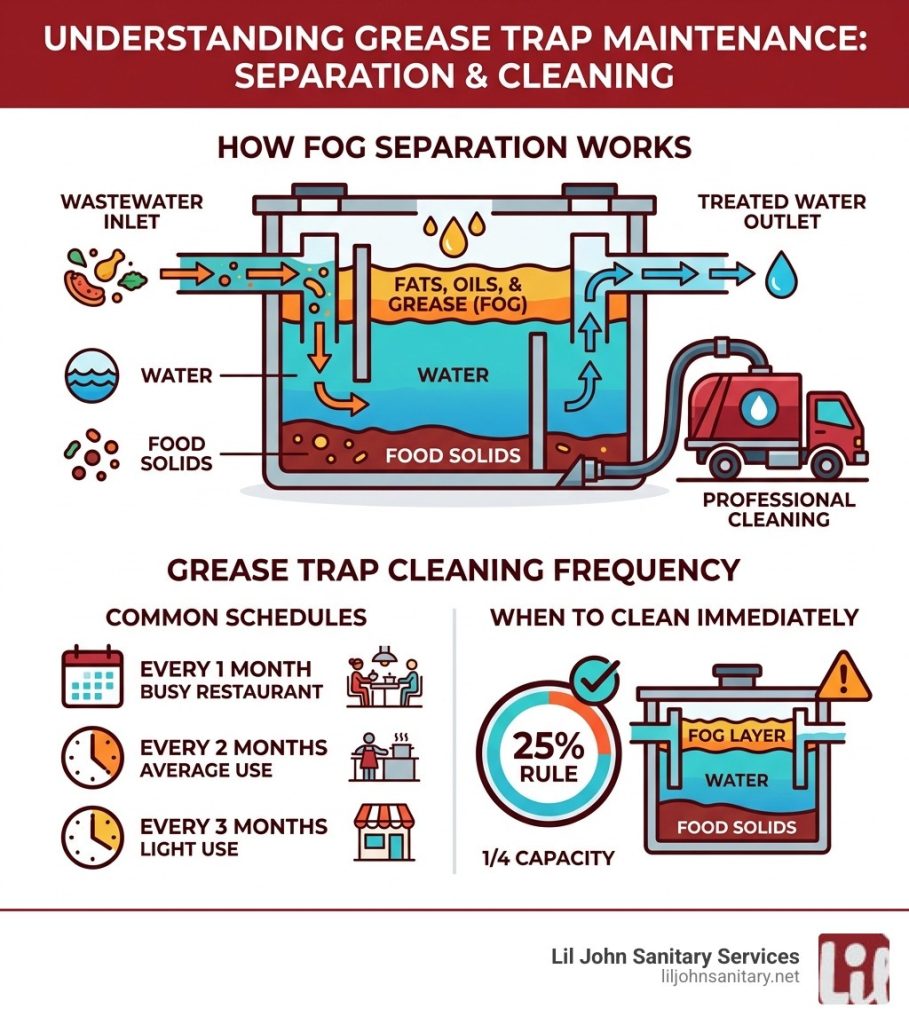
The separation process is a bit like a science experiment happening 24/7. When wastewater enters the trap, it hits a flow control device and a series of baffles (internal walls). These slow the water down, giving it time to cool.
As the water cools, physics takes over:
- Grease flotation: Because fats, oils, and grease are lighter than water, they float to the top.
- Solid settling: Heavier food scraps and “sludge” sink to the bottom.
- Clean discharge: The relatively clean water in the middle is pushed out into the sewer system.
Without professional maintenance, these layers eventually meet in the middle. When that happens, the trap can no longer do its job, and the “gunk” starts flowing directly into your pipes.
Why Regular Commercial Grease Trap Cleaning is Essential
We’ve seen it all in our 60 years of service—from minor clogs to full-blown kitchen floods. The Dangers Of Delaying Grease Trap Cleaning In Bellingham/ go far beyond a bad smell.
When FOG escapes the trap, it hardens like concrete inside your plumbing. This leads to:
- Health Code Violations: Inspectors in Skagit and Whatcom counties don’t take kindly to overflowing drains.
- Sewer Overflows: If your kitchen causes a backup in the city main, you could be liable for the cleanup costs.
- Business Interruption: You can’t serve food if your floor drains are geysering sewage.
| Feature | Grease Trap | Grease Interceptor |
| Location | Indoors (Under sink/floor) | Outdoors (Underground) |
| Capacity | Under 250 Gallons | 500 – 5,000+ Gallons |
| Cleaning Frequency | Monthly (typically) | Every 90 Days (typically) |
| Flow Rate | Low (under 50 GPM) | High (over 50 GPM) |
Maintenance Standards: The 25% Rule and Cleaning Frequency
In commercial grease trap cleaning, there is one golden rule we live by: The 25% Rule (also known as the one-fourths rule).
This rule states that a grease trap must be pumped and cleaned before the combined volume of grease and solids reaches 25% of the total tank capacity. Once you cross that 25% threshold, the trap loses its efficiency, and grease starts escaping into the sewer line.
Signs You Need Immediate Commercial Grease Trap Cleaning
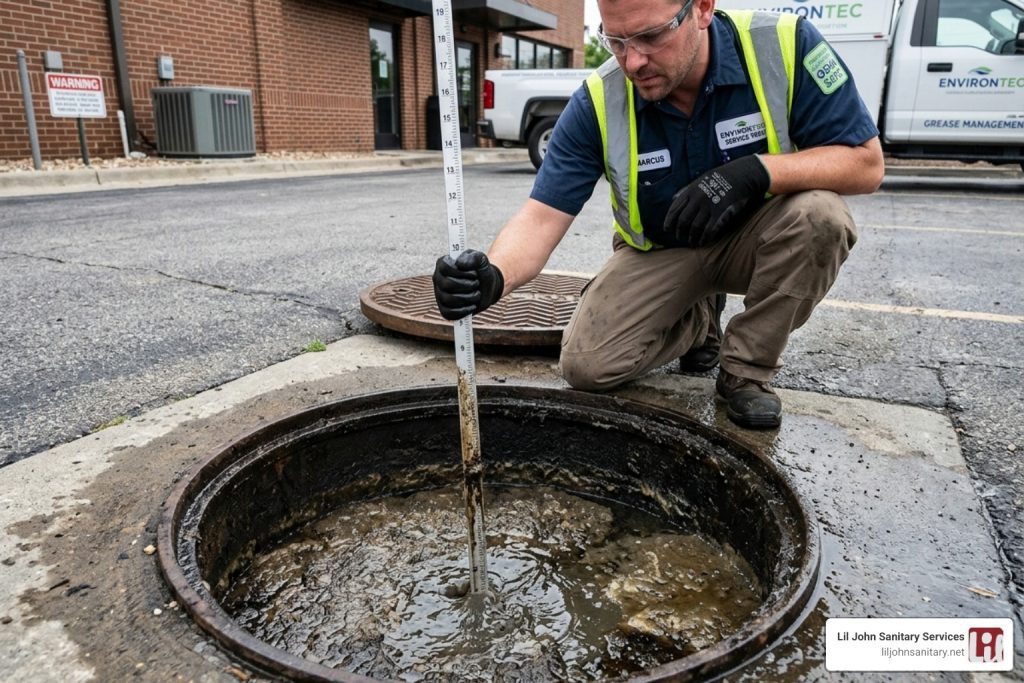
Sometimes, your kitchen will tell you it’s time for a visit before your scheduled date arrives. Recognizing A Grease Trap Emergency/ is key to avoiding a shutdown. Watch for these red flags:
- The “Slow Drain” Syndrome: If your sinks are taking forever to empty, the trap is likely restricted.
- The Funk: A persistent, rotten smell that doesn’t go away with standard cleaning.
- Gurgling Pipes: If your floor drains make noise when the sink is running, air is being trapped by a grease blockage.
- Visible Grease: If you see grease sitting in your floor drains, you are already in the “danger zone.”
Whether you are in a bustling downtown restaurant or need Signs You Need Grease Trap Cleaning In Birdsview/, ignoring these signs is a recipe for disaster.
Local Regulatory Requirements in Washington State
Compliance isn’t just a suggestion; it’s a requirement to keep your doors open. Grease Trap Requirements For Bellingham Food Establishments/ and similar codes across Whatcom and Skagit Counties generally mandate specific cycles:
- Hydromechanical Interceptors (Indoor traps): Usually require cleaning every 30 days due to their small size.
- Gravity Grease Interceptors (Outdoor tanks): Usually require a full pump-out every 90 days.
We help our clients stay on top of Grease Trap Maintenance Requirements For Food Establishments/ by setting up recurring schedules that satisfy local health inspectors and utility districts.
The Professional Cleaning Process and Compliance
When we arrive for a commercial grease trap cleaning visit, we don’t just “skim the top.” A professional service is a multi-step process designed to reset your system to zero.
- Evaluation: We measure the FOG levels to help you adjust your cleaning frequency.
- Full Evacuation: Using a high-powered vacuum truck, we remove every drop of liquid and solid waste.
- Manual Scraping: This is the “braving the stink” part. We scrape the interior walls and baffles to remove hardened grease that a vacuum alone can’t pull.
- Inspection: We check the “T” baffles and the structural integrity of the tank for cracks or corrosion.
- Flow Test: We ensure water is moving freely before we leave.
- Documentation: We provide a service manifest—your “get out of jail free” card for inspectors.
Beyond Pumping: Line Jetting and Repairs
Sometimes, the trap is clean, but the pipes leading to it are choked with years of “sludge.” This is where line jetting (or hydro-jetting) comes in. We use high-pressure water (up to 4,000 PSI) to blast the interior of your pipes clean. It’s like a power wash for your plumbing. For high-volume kitchens, we recommend jetting every 3 to 6 months to prevent the dreaded “midnight backup.”
We also keep an eye on your hardware. Baffles can corrode and fall off, which essentially turns your grease trap into a standard pipe—letting all the grease flow through. Catching these repairs early saves you thousands in potential fines and emergency plumbing bills.
Proper Waste Disposal and Record Keeping
What happens to that “liquid gold” we pump out? In May 2026, environmental regulations are stricter than ever. We ensure all waste is transported to permitted facilities where it can be processed—often being recycled into biofuels.
As a business owner, you must keep disposal manifests on-site. If an inspector walks in and asks for your records from six months ago, you need to have them ready. We provide the necessary paperwork to ensure you are always audit-ready.
Best Practices for Kitchen FOG Management
While we love seeing our customers, we want your commercial grease trap cleaning to be as easy as possible. You can significantly reduce the “gunk” by training your staff on a few simple habits.
Minimizing Buildup Between Professional Visits
Think of your grease trap as a trash can—the less you put in it, the longer it takes to fill up.
- Scrape, Don’t Rinse: Use a rubber spatula to scrape plates into the trash. Every bit of gravy or oil you scrape away is a bit that won’t clog your pipes.
- Dry Wipe: For greasy pans, use a paper towel to wipe them down before they ever hit the sink.
- The Mesh Screen Rule: Install fine-mesh strainers in every sink and floor drain. If it’s a solid, it belongs in the trash, not the trap.
- No “Hot Water Flushes”: Some folks think pouring boiling water down the drain helps. It actually does the opposite—it melts the grease just enough to move it further down into the city pipes where it hardens into a massive clog.
- Avoid Degreasers: Chemicals and enzymes might seem like a shortcut, but they often just “push” the grease downstream rather than removing it, which can lead to municipal fines.
If you’re wondering, “Can You Clean Your Commercial Grease Trap Yourself/” or “Can You Clean Your Own Grease Trap/“, the answer for small under-sink units is technically “yes,” but it is a messy, foul-smelling job that requires legal disposal of the waste. For anything larger than 25 gallons, you definitely want a professional team with a vacuum truck.
Check out our Grease Trap Cleaning Tips For Your Business In Lynden/ for more localized advice on managing your kitchen’s output. And remember, around the holidays, you need to be extra careful—learn What To Do With That Leftover Turkey Grease/ to avoid a Thanksgiving plumbing nightmare.
Frequently Asked Questions about Commercial Grease Trap Cleaning
How much does professional grease trap cleaning typically cost?
Pricing usually depends on the size of the trap and the volume of waste. A small under-sink trap might cost between $150 and $300, while large outdoor interceptors can range from $400 to $900+. Factors that increase the cost include:
- Access issues: If the trap is buried under a heavy planter or located in a hard-to-reach basement.
- Neglect: If the grease is so hard it requires extra time and hydro-jetting to break up.
- Emergency timing: After-hours or weekend calls always carry a premium.
What are the consequences of neglecting grease trap maintenance?
Beyond the smell, the financial hit can be massive. Fines for non-compliance in many Washington jurisdictions can exceed $5,000 per violation. If your neglect causes a sewage backup that damages neighboring businesses, you could face lawsuits and environmental remediation costs that reach tens of thousands of dollars.
Do grease traps require repairs or replacement?
Yes. A well-maintained steel or concrete trap usually lasts about 15 to 20 years. However, the acidic nature of decomposing food waste can “eat” through metal and concrete over time. If we find structural cracks or failing baffles during a cleaning, we’ll let you know immediately so you can plan for a repair rather than an emergency replacement.
Conclusion
At Lil John Sanitary Services, we’ve spent the last 60 years helping the Whatcom and Skagit County business communities stay “grease-free” and compliant. We are a family-owned, licensed, bonded, and insured team that understands the unique needs of Pacific Northwest kitchens.
From the Unexpected Benefits Of Grease Trap Cleaning In Everson/ (like a better-smelling dining room!) to routine Grease Trap Cleaning/ in Bellingham, Burlington, and beyond, we are here to make sure the “gunk” never wins.
Don’t wait for the floor drains to start gurgling. Whether you’re in Anacortes, Lynden, or Mount Vernon, give us a call to set up a maintenance schedule that keeps your kitchen flowing and your business thriving.
Ready to clear the air and the drains? Contact Lil John Sanitary Services today for professional grease trap cleaning!